




How would you anthropomorphize craft beer? Imagine it just showing up at your house one day unexpectedly. What do you see? Would you imagine a bearded bro with a beer belly, dressed in flannel, carrying a misfit six pack? Well, that image is officially a stereotype. Increasingly, women are embracing the craft beer movement both as customers and as a career path, and it should be no secret that women are the underutilized demographic that can take craft beer to new levels of popularity and credibility. It’s a fact that struck me when visiting Georgia’s traffic jam (also called Atlanta) to see SweetWater Brewing Co.
SweetWater was kind enough to invite CBB on a private tour of its facilities. During the walk-around, Tucker Berta Sarkisian (one of the many charismatic women in marketing and PR roles working in the beer industry) mentioned that SweetWater had the only two female two of only a few female brewers in Georgia working for them (Lindsey Kingry and Sarah Green); correction via Miranda Dohrman, brewer at Georgia’s Orpheus Brewing. As a historically male-centric beverage industry, I wondered what attracted these leading ladies to the world of beer. As you might expect, it’s the same thing that attracts almost everyone else.
“Like a lot of brewers, my interest in the industry began with a healthy love of beer,” Kingry explained. “While it’s traditionally been a male-dominated industry, especially on the production side, it’s a demographic that’s rapidly changing as the craft brewing industry evolves as in any other industry. It’s not surprising that more women are becoming involved in the craft brewing scene because the pattern jibes with new societal norms as the traditional gender roles evolve.”
Today, it’s not hard to find female leaders running the brewhouse, running the marketing squad, working the packaging line or drinking craft beer at the bar, but how do you start to get involved in the industry and how hard is it to get those jobs in brewing? As a career, the first step toward brewing can be the most difficult. Luckily, work ethic is gender neutral.
“The craft brewing industry is open when it comes to successes and failures, and yes, there are several of both. It’s all about learning from those failures, and the successes will follow,” said Emily Parker, director of brewery operators at Schlafly Beer. “This is an industry where you’re constantly learning from whatever you run into from day to day, and it’s filled with innovative people that are trying things that haven’t been done before, which makes it exciting.”
Build your network
Not a news flash: In 2016, beer is big business. You’ve probably heard the brewing market has exploded with more than 4,000 breweries in the United States (the most ever). That means there are a growing number of jobs in the brewing industry for women and anyone else. Even outside of the breweries themselves, opportunities abound with distributors, suppliers, retailers, media members and community groups that provide fulfilling career paths or even just camaraderie for women who like beer.
The beer industry is not unlike a family, and the people who work in the industry often have an impressive web of relationships with beer makers, sellers and servers. So first off, build those beer friendships.
“The way that I got myself into the beer industry was solely based on networking and building relationships,” said Emily Erler, retail sales manager in Chicago for the Global Beer Network, which imports nearly 60 award-winning Belgian Beer labels to America. “In my opinion, it was easy because beer became such a passion for me at a young age. The tie-in with my father, a homebrewer, was one that allowed beer brewing and sampling to be something we spent time doing together, a hobby and a love. I took that passion and allowed it to show in many service industry jobs I held. I felt a sense of pride being the go-to source for my co-workers for tasting notes and recommendations to pass along to guests. You could say I made friends fast that way and became recognizable in the Milwaukee craft beer crowd. I am, and never was, afraid to ask questions — lots of them if you ask my co-workers — and was always very curious and enthusiastic to try new things.”
Sometimes making friends can be tough. Erler noted that the Milwaukee beer scene in particular is very much still a male-dominated market, so sometimes the ladies stick out.
“I have found myself very frustrated at times feeling as though I just wanted to be taken seriously and seen as one of the guys,” she explained. “During my time in Milwaukee, I became a member of several all-women homebrewing clubs [like Barley’s Angels] and attended girl-centric happy hours with other beer gals like me. That helped a lot to boost my confidence and spend time with peers.”
There is power and knowledge in numbers, so don’t be hesitant to seek out the great organizations for women in the beer industry to network. One of our favorites is the Pink Boots Society, a group of more than 2,000 members and counting, created to empower women beer professionals, advance women brewing careers and make damn good beer along the way. Headed by award-winning Portland, Ore., craft brewer Teri Fahrendorf, the Pink Boots Society has been supporting women in brewing since 2008. The society has two main tenants:
- Support Pink Boots Society members to advance their beer careers through education.
- Teach women beer professionals the judging skills necessary to become beer judges at the Great American Beer Festival and other competitions.

For women just looking to get into beer, we suggest Girls Pint Out, which started in early 2010 in Indianapolis as an informal group for women who love craft beer. There is no membership process to be involved, and it’s a nonprofit with 86 chapters in 40 states. Check out its chapter directory right over here.
“Men don’t care if you are a woman working in the beer industry as long as you know beer,” said Amanda Wishin, president of Girls Pint Out. “The same goes for brewing — brew good beer and no one cares that you are a woman, just that you make good beer. Our goal and the goal of Girls Pint Out is to be a welcoming place that plans events geared toward women. Our attendees span from novices who don’t know anything about beer to brewers and brewery owners. Our events are charitable, social or educational and run the gamut from homebrewing sessions to coloring and craft beer nights. Each chapter has its own personality, and I encourage them to plan events that suit them.”
Get schooled
If you want to be successful in the increasingly competitive beer industry, knowledge can be your advantage. Luckily, education programs that cover everything from brewing chemistry and brewery ownership to sales and marketing and restaurant management are popular all over the country (check some out here). Whether you’re a new brewer with a dream or just a beer fan wanting to expand your horizons, there’s probably a local or national educational institution ready to teach you more. Parker from Schlafly took the traditional college route.
“After researching more about what the degree in the food and science space entailed, it felt like a great fit for me,” she explained. “I had been really into science more than other subjects. I took a course called Intro to Brewing and Viticulture, and I must say the brewing aspect won me over. Charlie Bamforth, the Professor of Brewing Science at UC Davis, was in my opinion the best professor I had during my time at UC Davis. He is the reason I went on to pursue my career in brewing, and it was truly an honor to learn from him. With my education in food science, with an emphasis in brewing, I knew the industry was a fit for me from the beginning. I completed internships at Shiner and Stone. Once I completed my degree, I landed an internship at Schlafly which turned into a full-time position. I have been at Schlafly now for almost six years.”
Of course, not everyone wants to or needs to go to college to find a successful career in the beer industry. If you are a woman with enough passion, you’ll usually find your way. SweetWater brewer Sarah Green is a great example. For almost three years after college, she was a paralegal with absolutely zero passion for a future as an attorney. Out of boredom and at the suggestion of her best friend who already worked there, she started hostessing at Goose Island Brewing Co.’s Clybourn Brewpub. Ever since, she’s been learning her way through the industry.
“As for my education, I am almost entirely self-taught with the exception of a few brewing courses I took at AB-InBev’s online university,” Green said. “Even though I went to college for anthropology and don’t have a brewing or science degree, I don’t believe it has held me back in any way. It can absolutely help, but I don’t think it’s absolutely necessary.”
But what is necessary (degree or not) is an obsessive attitude toward the job and industry. While Green does not have a degree, she is the epitome of a beer geek.
“A few months into hostessing, I asked if I could give brewery tours on the weekends,” she explained. “I had little to no knowledge of the brewing process, but it seemed like a fun gig, drinking and talking about beer. With the blessing and encouragement of the then GM Reggie Snead, I dove headfirst into studying beer. The world of beer fascinated me — its history from the dawn of civilization to now, biology, chemistry, food and cultures. I would come home from work on Fridays, go for a run, study, not drink beer for a few hours, then go to bed excited and ready for my tours the following day. Each week, I learned a new way that beer had shaped the world and eagerly told everyone who would listen.”
She eventually quit the law firm to work as a brand ambassador for Goose Island’s production brewery (at the time a separate entity from the brewpub). After a year of that, she took a brewing internship. “After my first shift, I was drenched in sweat, covered in beer, exhausted mentally and physically but absolutely exhilarated,” Green remembered. After the six month brewing internship ended, she moved to Atlanta for a position with SweetWater where “I have been happily brewing away the days.”
Click Next below or you’ll never learn about average salaries in professional brewing, and you want to get paid fairly, right?
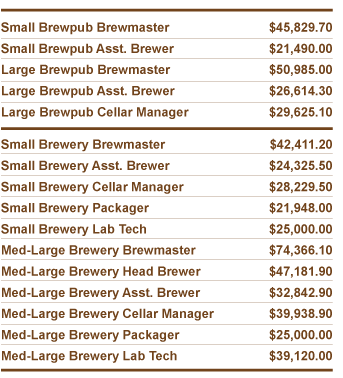
The price of success is hard work, dedication to the job at hand and the determination to apply the best of ourselves. While that price comes from within, women should still be aware of the price of their time and effort. Below is an awesome chart of average brewery salaries via craftbeer.com.
Average Brewery Salaries
Learn your women-in-beer stats
Beer’s magnetism attracts all races, all ages and all genders. One might say the diversity of craft beer in America represents the diversity of craft beer characters in the industry. While it’s easy to say one of the most passionate and character-driven demographics in the craft beer industry is women, is that really true? How many women are actually working in the beer industry? We decided to ask Bart Watson, economist for the Brewers Association (BA). Watson shared with us some interesting data from a Stanford research team, which can be attributed to Dr. Sarah Soule and Dr. Shelley Correll, both of Stanford University. Listen to these numbers:
For founder (of breweries from 2014 that were still open at the time of their research), they coded 1,993 breweries (the rest they couldn’t find info on, etc.). Of those, they found that 20 percent (399) had at least one female founder, of which 40 (2 percent) had an exclusively female founder(s).
For CEO, they coded 2,095, of which they found that 17 percent (349) had at least one female CEO — only 67 of those (3 percent) had an exclusively female CEO, the rest were co-CEOs with at least one male (typically wife/husband team). The headbrewer/brewmaster stats show the least females. They coded 1,717 and only found 4 percent (76) with a female head brewer/brewmaster. Of those, only 2 percent (38) were exclusively female.
In all, they were able to code at least one of those categories for 2,536 breweries. Of those 21 percent (543) had at least one woman as founder/CEO/or brewmaster/head brewer.
While this information is a few years old, we can see that women still have an enormous space to grow within the brewing industry. According to the Beer Institute, the industry supports some 1.75 million American jobs, and it’s growing aggressively — craft breweries specifically. In 2015, craft brewers produced 24.5 million bbls and saw a 13 percent rise in volume and a 16 percent increase in retail dollar value. Craft breweries already support an ethos of community empowerment, environmentalism and charity, so why not increasing gender equality? It seems like a natural fit.

In terms of sheer economics, we will definitely need more women as workers and as beer drinkers in order for the industry to grow. Looking at the stats, younger women are identifying more with beer and craft beer specifically. On women as customers, here’s some Nielsen data via Watson and the BA. The percent in the graph is the percent of craft volume that a group consumes. The second is their “index” where 100 means that group consumes the same percent as their percent in the population, so young women overindex on craft and older women under-index.
| Females 21-24 | 4.2% | 114 |
| Females 25-34 | 10.4% | 113 |
| Females 35-44 | 6.5% | 72 |
| Females 45-54 | 4.8% | 48 |
| Females 55-64 | 3.9% | 42 |
| Females 65-74 | 1.3% | 21 |
| Females 75 or More | 0.5% | 11 |
“I think one reason that the 21- to 34-year-old female group overindexes is that craft brewers don’t market to gender at all — they market to beer lovers,” explained Watson. “There are certainly still small brewers that return to the more traditional male-centric beer marketing, but in general, craft brewers are marketing to their local community regardless of gender. I actually can’t think of too many female-specific marketing campaigns, but your average small brewer is simply using gender-neutral marketing.”
Get some advice from top women in brewing
Armed with all of this info, how do you translate your enthusiasm into an actual job? Some people get their start with a cold application. Just waltz right into your favorite local brewery and let them know that you are interested in working hard. Drop off your resume to HR or finagle lunch and a beer with a hiring manager. Just be ready to say things like, “I’ll do just about anything you need me to do around here” because competition is fierce (regardless of gender). Volunteering to give tours, help with odd jobs or work events is also a great way to build some beer cred. Once you do find that open position, here’s some solid advice from women who are already very successful in the beer industry.
Marina Koulogeorge
 Sales representative-Chicago with Louis Glunz Beer Inc.
As far as advice goes for women looking to join the industry, I would say be strong and be yourself. While this might still be considered a male-dominated industry, I encourage women to join. I really thank Louis Glunz Beer Inc. for their extensive education and training for sales reps across product knowledge. Knowing your portfolio and your competitor’s portfolio is key. Educate yourself, too — there are so many ways to expand your knowledge of the industry, from books to websites and more. It’s also extremely important to know your customers, get to know their customers and pay attention to what consumers are buying. Gain the trust of your customers by building relationships and that will truly go a long way. This job can be challenging, but it’s an extremely rewarding one to have if you’re passionate about the industry. Your work ethic will pay off more than you know, so plan on working hard and staying strong, and lastly, enjoy it.
Sarah Green
Brewer with SweetWater Brewing Co.
 Be passionate and ready to work your ass off but don’t lose your sense of humor. You’ll work 10, 12, 14 hour days; a sense of humor (and beer) helps everyone get through the long hours. If you don’t have experience, get your foot in the door at a brewery in any way possible. Be a regular in the tap room, volunteer to help the brewers shovel spent grain out, hand bottle or can or volunteer to pour at fests. The most important piece of advice given to me when I started brewing: Always ask questions and never stop asking why. Five brewers will give you five different ways of doing the same process at the same brewery. Know why. A fresh pair of eyes is a fresh perspective. You might see a more efficient way of doing a process, so speak up if you think of a better way.
Emily Erler
Retail sales manager-Chicago with the Global Beer Network
 When gearing up for the position with Global Beer Network, a couple words of wisdom that I think helped me: Make eye contact. One way I have found to be taken seriously is really a small detail, but look whomever in the eye when you’re interviewing. It shows confidence and it shows you mean business! When you interview for a beer industry position, you are likely speaking to a fellow beer lover or nerd, so the whole “fake it till you make it” only goes so far. You never know when your interviewer will ask you about IBU and ABV ranges for specific beer styles (yes, this has happened to me before). Lastly, a piece of advice from my old man: Go with the firm handshake. No wimpy wrists.
Emily Parker
 Director of brewery operators at Schlafly Beer
First things first: “It’s always been this way” is bull. It’s an excuse for complacency. Every day in the brewery, you can and will be confronted with countless decisions and situations. Face every single one of those with the confidence that if you don’t know the answer right then, it is OK. You will not have all the answers all the time, but you open yourself up to growth and trustworthiness when you can answer “I’m not sure, but I’ll find out.” But here’s the key — go figure it out! Know when you don’t know, but also know you can find the answer. Sometimes the people around you can be your best resource. Leveraging your team, your combined knowledge and your trust in each other will help you face any challenge and work toward finding the answers you need.
Lindsey Kingry
 Brewer with SweetWater Brewing Co.
The best advice I can give another woman trying to enter the craft brewing business is study, study and study some more. Pick a brewing education program that fits your needs. Read as many MBAA or ASBC articles as you can. Follow blogs that keep you informed on the industry [ahem]. Put yourself in a position so that when you walk into an interview or your first day at a new job you know what it is all about. Education and knowledge is power, and it is something no one can ever take away from you.


